
Industries
College and University Cleaning in San Jose
College and university cleaning for San Jose campuses: teaching labs ready for the next class, residence halls ready for move-in, and lecture halls, libraries and offices cleaned around lab rules, shop hours and the academic calendar.
Campus cleaning priorities
College and university cleaning in San Jose should start with the hardest rooms on campus. This page is for facilities directors, custodial and housing managers and auxiliary services staff who run campus buildings, and it opens with the spaces that ask the most of a crew: teaching labs, engineering shops and the corridors that tie them together.
Our commercial cleaners look after every other building type too, from lecture halls and libraries to residence halls, student unions, recreation centers and administrative offices. Your campus sets the standard for each building, and the crew works to it on the schedule your facilities department writes.
Teaching labs run on the lab’s protocol
Crews clean the parts of a teaching lab that the lab hands over: floors, trash and recycling that is not lab waste, paper and soap restocking, sinks that lab staff clear for cleaning, and fume hood exteriors where staff allow it. Bench tops, instruments, chemical waste and anything inside a hood stay with lab staff until they release a surface. Each lab’s own protocol draws that line, and the crew follows it room by room.
Your lab managers tell the crew supervisor which rooms follow which routine, and product choices follow your campus’s purchasing and sustainability rules. Rooms with gowning or particle limits are handled through our cleanroom, data center and lab cleaning service.
Engineering shops and the corridors outside
Engineering shops and student maker spaces wear differently from a classroom. Dust, offcuts and grit travel from the machine area into hallways, stairwells and elevators, and from there into the rest of the building. Crews sweep and scrub shop walkways and open floor, empty trash and recycling, and clean the restrooms and break rooms nearby. Machines, tool benches and student projects are never moved or touched, and the floor around a machine is cleaned only once shop staff clear it.
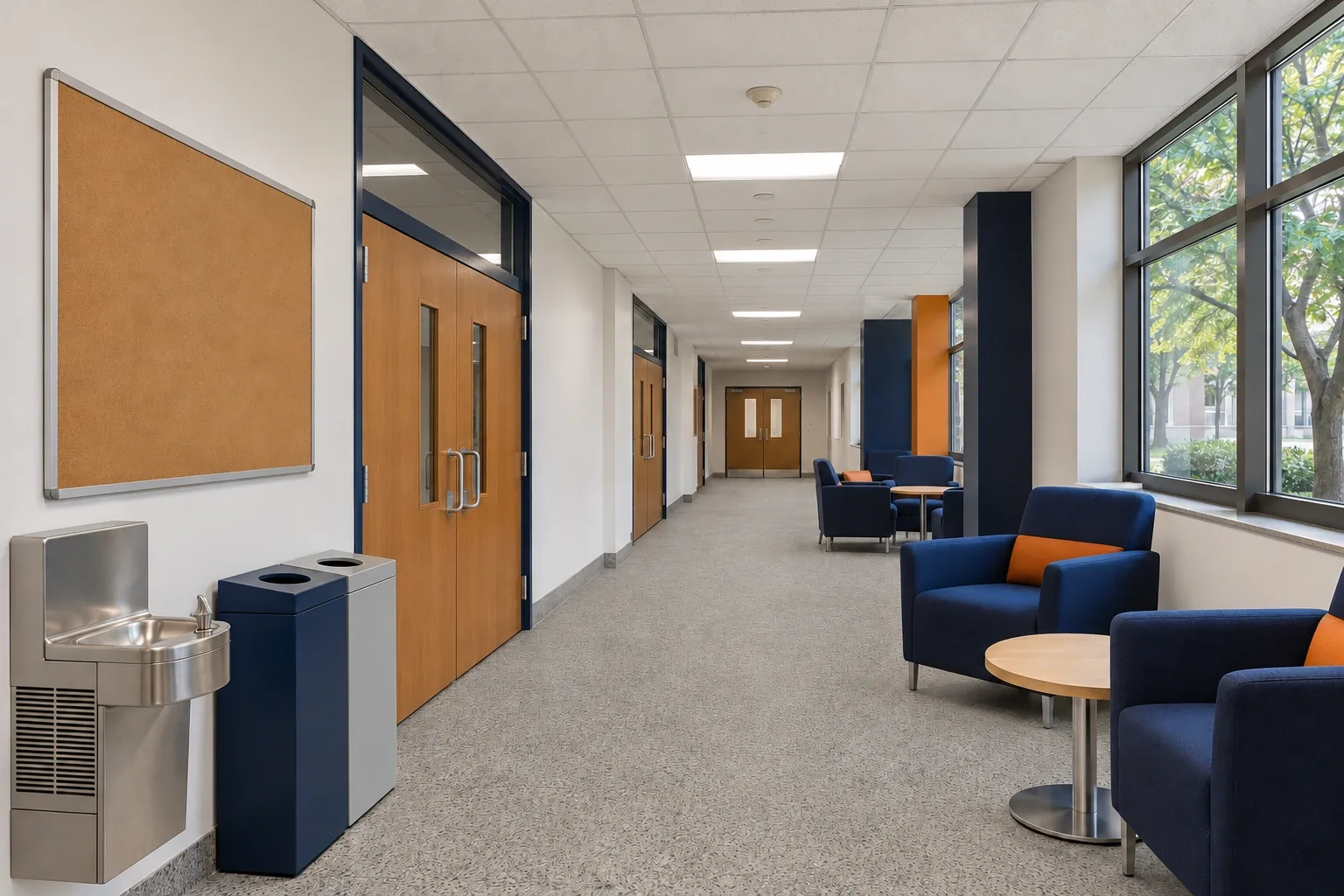
The corridors outside labs and shops carry that dust further than any other route, so they get attention on the cycle your facilities team sets: dust-mopping or vacuuming, spot mopping, and wiping door handles, push plates, stair rails, elevator buttons and drinking fountains. Machine scrubbing and refinishing through commercial floor care keep those hard floors bright, and tall stairwells and atriums can add high dusting from lifts on a quiet night.
What college and university cleaning covers
Every building on a campus has its own list. The table shows what crews clean in each one; how often each task happens comes from your facilities department.
| Building or space | What crews clean |
|---|---|
| Teaching labs | Floors, trash and recycling, restocking and the sinks lab staff clear, all to the lab’s protocol |
| Engineering shops and maker spaces | Walkways and open floor, trash, nearby restrooms and break rooms, with machines and benches left alone |
| Lab corridors, stairwells and elevators | Hard floors, door hardware, stair rails, elevator buttons and drinking fountains |
| Lecture halls and classrooms | Desks, tables and seat rows, boards and trays, trash, floors and chairs set back in place |
| Libraries and study rooms | Study tables and carrels, computer stations, carpet, entries and restrooms |
| Residence halls | Lounges, shared bathrooms, hallways and stairwells, plus room turnover between terms |
| Unions and dining commons | Tables, chairs, trash and recycling stations, floors and restrooms; cleaning only, never food service |
| Recreation centers | Locker rooms, showers and workout floors, as described on our gym and fitness center cleaning page |
| Administrative offices | Clear desks, conference rooms, break rooms, trash and carpet |
Restrooms in any building can add a periodic restroom deep cleaning, entry glass and low-rise windows go to commercial window cleaning, and paper, soap and liners can arrive with the service through janitorial supplies.
Chemical safety in shared lab buildings
When our crew works inside a campus lab building, two employers share one workplace, and California’s hazard communication standard (8 CCR 5194) covers that case. The written hazard communication program in a multi-employer workplace has to say how each employer tells the others about hazardous chemicals their workers could be exposed to, for example by sharing Safety Data Sheet access, precautions and the labeling system in use. The same standard keeps Safety Data Sheets readily accessible on every shift and calls for training on a work area’s chemicals at first assignment and whenever a new hazard is introduced.
On a campus, that means your facilities office receives our product list and Safety Data Sheets, and your lab managers brief the crew supervisor on the hazards in each room. APPA’s cleaning chapter adds that a paper set of Safety Data Sheets belongs on site for emergencies, and our free SDS binder kit lays one out. Disinfecting always starts with cleaning: crews clean the surface first, then apply an EPA-registered disinfectant and keep it wet for the contact time on its label.
Your campus picks the appearance level
The campus decides how clean each building should look, and many campuses express that through APPA’s appearance levels. APPA’s custodial guidelines describe five of them, running from Level 1, the cleanest, to Level 5, the most neglected. Its cleaning chapter advises agreeing on the level with the faculty, students and staff in each building and the crew that cleans it, then writing it down so the tasks and their frequency are clear to everyone.
| Level | APPA’s label | What it looks like, in brief |
|---|---|---|
| 1 | Orderly spotlessness | Bright floors with no build-up at the edges, surfaces free of dust and fingerprints, gleaming stocked restrooms and every light working |
| 2 | Ordinary tidiness | Floors still bright, though up to two days of dust or streaks can show and smudges appear up close |
| 3 | Casual inattention | Floors swept but stained up close, dull walking lanes, and obvious dust and fingerprints |
| 4 | Moderate dinginess | Dull, stained floors, conspicuous dust, old sour-smelling trash and some lamps out |
| 5 | Unkempt neglect | Widespread build-up, gum and litter, overflowing bins and more than 5% of lamps out |
Whatever level your campus names, the crew cleans to the task list and frequencies your facilities department sets for each building.
Terms, finals and the summer break
Campus cleaning in San Jose follows the academic calendar. During the term, lab buildings and classrooms are reset after the last section and evening class, and shop floors are cleaned once the machines shut down for the night. When finals change building hours, visits move with them, so nobody studying or finishing a project is interrupted by a floor machine.
Move-out and summer are when the heavy work fits. Residence halls are turned over between terms, while lounges, bathrooms, hallways and stairwells stay on a regular cycle. Quiet summer weeks also suit stripping and refinishing lab corridor and shop floors, and deep carpet cleaning in libraries and residence halls, on whatever cycle your campus sets.
Campus events add their own load: a restroom and trash refresh beforehand, trash patrols and restroom checks during the event, and a heavy cleanup before the next day’s routine service. Our event venue cleaning handles that kind of turnaround in campus halls and auditoriums.
Keys, cards and background checks
Access stays under campus control. Your facilities office decides who holds keys and cards, for how long and on whose sign-off, and nothing it issues is ever loaned or copied. Crews carry only the keys and cards your campus issues and follow each building’s sign-in and lock-up rules.
Background checks work the same way. Our crews are background-checked, and your campus tells the crew supervisor which buildings and programs, such as summer camps with minors on site, carry their own screening rules.
Day, swing or late-night shifts
APPA names three shift options for campus custodial work, day, swing and late night, and advises choosing among them with the building’s occupants and the people doing the cleaning. Daytime cleaning puts crews where staff can flag a problem and see it fixed quickly, and it trims lighting, heating and cooling hours. The trade-off is working around occupied rooms and keeping noisy equipment away from classes.
A lab building can combine day and night work: a day porter restocks restrooms and wipes high-touch points between classes, and the night crew takes the floors and the full reset. Our guide on day porter versus nightly janitorial service compares the two.
Campuses in and around San Jose
Higher education in San Jose spans a state university campus and community colleges, each with its own mix of labs, classrooms, shops and student housing.
Our crews work throughout San Jose, with neighborhood pages for North San Jose and Downtown San Jose. Elementary, middle and high schools are covered on our school cleaning page.
Getting a campus cleaning quote
Campus pricing is built building by building. The main factors are square footage by building type, the number of labs and shops and the routine each one follows, the appearance level your campus has chosen, restroom and residence hall counts, porter hours, summer floor work and the event calendar.
We are insured and bonded and carry workers’ compensation, supervisors run quality inspections, and a certificate of insurance goes to every client. List your buildings, labs and shops in the quote form, and each building is priced on its own line.
Common questions
Who cleans the lab benches and fume hoods?
Your lab staff, until they clear a surface for us. Crews take the floors, trash that is not lab waste, restocking and cleared sinks, and wipe hood exteriors where staff allow it, all to the lab’s protocol.
Do you clean engineering shops and maker spaces?
Yes. Crews sweep and scrub shop walkways and open floor, empty trash and clean the nearby restrooms and break rooms, leaving machines, benches and student projects untouched.
Which APPA level do your crews work to?
The level your campus chooses. Many campuses describe the look they want with APPA’s five appearance levels, and the crew works to the task list and frequencies your facilities department sets.
How do you share chemical information with our lab managers?
Your facilities office receives our product list and Safety Data Sheets, and lab managers brief the crew supervisor on each room’s hazards, the exchange California’s hazard communication standard expects in a shared workplace.
Can heavier floor work wait until summer?
Yes. Stripping and refinishing lab corridors, shop floors and residence hall hallways fits the quiet weeks after move-out, while routine cleaning keeps running for summer programs.